7 Dangerous Myths About Language Learning That Are Holding You Back
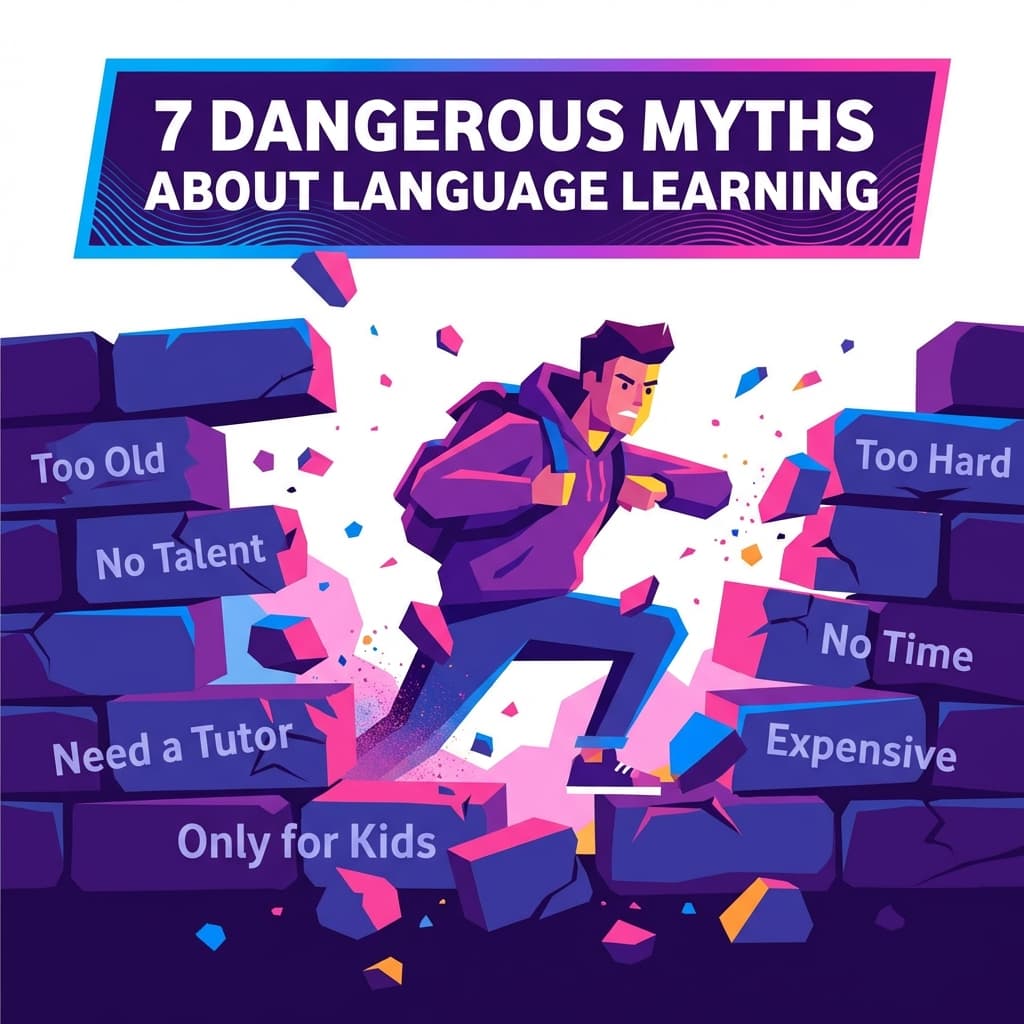
The biggest barrier to learning a language isn't grammar, vocabulary, or pronunciation. It is psychology. Many of us harbor self-limiting beliefs that sabotage our progress before we even begin. Let's look at the myths that need to die.
Myth 1: "I'm too old to learn."
Fact: While children are better at acquiring accents, adults are statistically better at understanding complex grammar concepts and possessing the discipline to study. Neuroplasticity exists throughout your entire life. You can learn at 20, 50, or 80. The method just changes.
Myth 2: "I don't have the 'Language Gene'."
Fact: There is no such thing. Everyone learned their native language perfectly. While some people may have a slight aptitude for auditory processing, 99% of language success is effort and time. "Talent" is usually just a mask for thousands of hours of unseen practice.
Myth 3: "I need to live in the country to learn."
Fact: There are expats who have lived in Japan for 20 years and can't order a beer. There are teenagers in rural Brazil who speak perfect English. Immersion is a state of mind, not a GPS location. With the internet, you can create an immersion environment anywhere.
Myth 4: "Mistakes are bad."
Fact: Mistakes are data points. If you aren't making mistakes, you aren't pushing your boundaries. The learner who makes 100 mistakes a day learns 100 times faster than the perfectionist who stays silent to avoid error.
Myth 5: "English is the hardest language / X is the hardest language."
Fact: Difficulty is relative. For a Korean speaker, Japanese is easier than English. For a German speaker, English is easy. Stop focusing on how "hard" it is—that's just an excuse to procrastinate.
Myth 6: "I need to be fluent to be useful."
Fact: You can travel, make friends, and navigate a city with A2 (survival) level language proficiency. The goal shouldn't be "perfection"; it should be "connection".
Myth 7: "AI will replace language learning."
Fact: Translation apps are great for business docs, but they can't translate human connection. Speaking to someone in their soul language builds trust and rapport that a machine cannot replicate. AI is a tool to help you learn, not a replacement for your brain.